
Ecotera Asia
Accessible Environmental Monitoring
Our Innovation Ecosystem
ecotera asia Pte. Ltd. is an independent Singapore company focused on advancing environmental monitoring and human health technologies throughout Asia, Oceania, Africa and the Middle East.
While ecotera asia collaborates with a broader network of independent organizations, each organization operates separately with its own management, strategy, and mission.
Together, these organizations help accelerate innovation across the environmental health continuum—from environmental monitoring to human diagnostics, therapeutics, and regional commercialization.
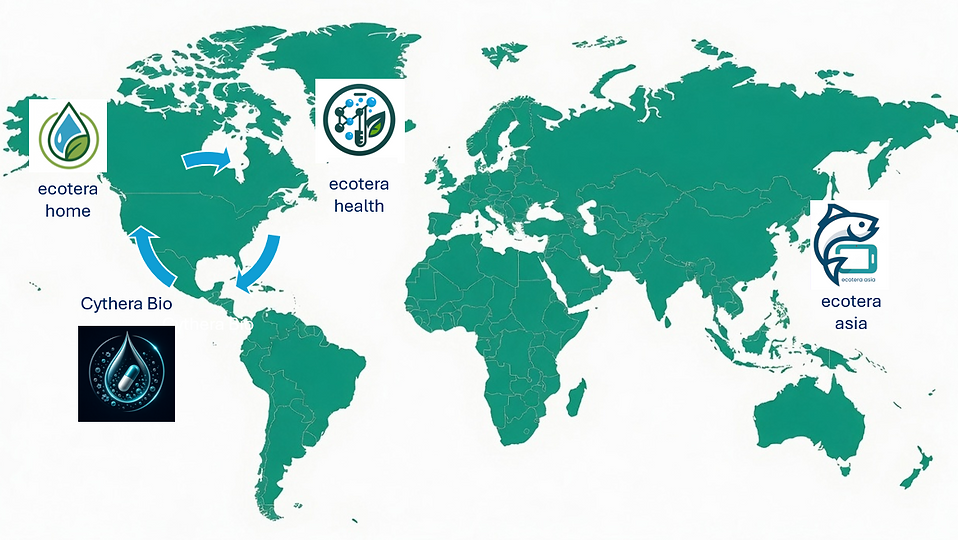

AI-powered environmental monitoring
• Smartphone-based monitoring
of microplastics / nanoplastics
• Drinking water and
environmental testing
• Decentralized
environmental monitoring
US Company
Americas • Europe •Antarctica

Human Diagnostics
• AI-powered diagnostics for
microplastic and nanoplastic
exposure
• Urine, blood, saliva, and future
biological matrices
• Companion diagnostics,
translational research, and
population health applications
US Company
Americas • Europe •Antarctica

Precision Environmental Health innovation
• Novel supplements and
therapeutics for
environmentally associated
conditions
• Translational research
supporting personalized
medicine
US Company
Americas • Europe •Antarctica
Status:
- Urine Diagnostic Development with US FDA Regulatory filings and human samples
- Blood Diagnostic: Proof-of-Concept Simulated Blood
Selected Relevant Papers:
A Multi-Matrix Approach to Microplastic and Nanoplastic Detection Across Environmental and Biological Samples
https://doi.org/10.5281/zenodo.19462123
Human Health Impacts and Tissue Deposition of Microplastics and Nanoplastics: Organ-System Summary (April 2026)
https://doi.org/10.5281/zenodo.19663994
Technical Note: EcoExposure Platform for Multi-Matrix Detection in Intact Liquid Media Across Industries and Fields
https://doi.org/10.5281/zenodo.19903089

Key Points:
-
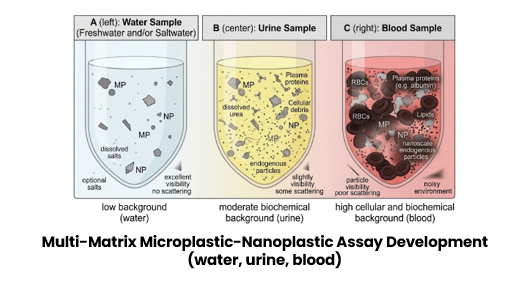
Water as the foundation: Freshwater and saltwater provide lower-background systems that are useful for initial method development, calibration, and real-world environmental monitoring.
-
Extension to urine: Urine introduces moderate biochemical complexity (salts, urea, proteins, debris), creating an important bridge between environmental testing and human exposure monitoring.
-
Future blood applications: Blood is a highly complex matrix with cells, proteins, lipids, and strong optical interference, but it may enable deeper understanding of systemic exposure and disease relationships.
-
Shared analytical principles: Core detection concepts—optical signals, particle interactions, aggregate patterns, and matrix-aware interpretation—can be adapted across sample types.
-
From environment to health: Integrating water and human testing may help connect environmental contamination with measurable biological exposure.
-
Scalable monitoring vision: A multi-matrix strategy supports future decentralized testing, longitudinal data collection, and broader public health intelligence.
-
Why it matters: Most existing methods are optimized for a single matrix. A cross-matrix approach aims for greater consistency, comparability, and real-world usability.
Our Innovation Ecosystem
ecotera asia Pte. Ltd. is an independent Singapore company focused on advancing environmental monitoring and human health technologies throughout Asia, Oceania, Africa and the Middle East.
While ecotera asia collaborates with a broader network of independent organizations, each organization operates separately with its own management, strategy, and mission.
Together, these organizations help accelerate innovation across the environmental health continuum—from environmental monitoring to human diagnostics, therapeutics, and regional commercialization.

AI-powered environmental monitoring
• Smartphone-based monitoring
of microplastics / nanoplastics
• Drinking water and
environmental testing
• Decentralized
environmental monitoring
US Company
Americas • Europe •Antarctica
Status:
- Urine Diagnostic Development with US FDA Regulatory filings and human samples
- Blood Diagnostic: Proof-of-Concept Simulated Blood
Selected Relevant Papers:
A Multi-Matrix Approach to Microplastic and Nanoplastic Detection Across Environmental and Biological Samples
https://doi.org/10.5281/zenodo.19462123
Human Health Impacts and Tissue Deposition of Microplastics and Nanoplastics: Organ-System Summary (April 2026)
https://doi.org/10.5281/zenodo.19663994
Technical Note: EcoExposure Platform for Multi-Matrix Detection in Intact Liquid Media Across Industries and Fields
https://doi.org/10.5281/zenodo.19903089
Key Points:
-
Water as the foundation: Freshwater and saltwater provide lower-background systems that are useful for initial method development, calibration, and real-world environmental monitoring.
-
Extension to urine: Urine introduces moderate biochemical complexity (salts, urea, proteins, debris), creating an important bridge between environmental testing and human exposure monitoring.
-
Future blood applications: Blood is a highly complex matrix with cells, proteins, lipids, and strong optical interference, but it may enable deeper understanding of systemic exposure and disease relationships.
-
Shared analytical principles: Core detection concepts—optical signals, particle interactions, aggregate patterns, and matrix-aware interpretation—can be adapted across sample types.
-
From environment to health: Integrating water and human testing may help connect environmental contamination with measurable biological exposure.
-
Scalable monitoring vision: A multi-matrix strategy supports future decentralized testing, longitudinal data collection, and broader public health intelligence.
-
Why it matters: Most existing methods are optimized for a single matrix. A cross-matrix approach aims for greater consistency, comparability, and real-world usability.
AI-powered environmental monitoring
• Smartphone-based monitoring
of microplastics / nanoplastics
• Drinking water and
environmental testing
• Decentralized
environmental monitoring
US Company
Americas • Europe •Antarctica