
Beyond Object Detection: AI for Optical Assays and Real-World Diagnostic Intelligence

Abstract Artificial intelligence in imaging is most commonly associated with object detection, segmentation, and classification. While these capabilities are powerful, they do not represent the full potential of computer vision for scientific and environmental applications. Many high-value real-world assays generate information not through discrete identifiable objects, but through dynamic optical signals such as color shifts, spatial clearing patterns, aggregation behavior, gradients, texture changes, and time-dependent transformations. This paper proposes a broader framework—AI for optical assays—in which the system interprets assay-generated signals rather than simply locating objects. The approach is particularly relevant to environmental monitoring, decentralized diagnostics, and real-world intelligence platforms such as the EcoExposure™ system. By moving beyond traditional object detection, this paradigm opens new possibilities for scalable, field-deployable solutions to complex measurement challenges, including microplastics and nanoplastics detection. This paper is also available at: https://doi.org/10.5281/zenodo.19873271
Figure 1. Why object detection alone is insufficient for microplastic and nanoplastic analysis. When many people think of computer vision, they assume object detection frameworks such as YOLO. However, in real environmental samples, practical detection limits are often constrained to larger particles (e.g., ~100–300 μm) by camera resolution, image down-sampling, turbidity, overlap, and low contrast. This creates a major gap relative to nanoplastics (~100 nm) and many smaller microplastics, motivating alternative AI approaches based on optical signals, patterns, and assay-generated information rather than direct particle localization alone.

1. Introduction: The Limits of the Current AI Narrative
When most people hear “AI vision,” they think of object detection tasks: identifying cats and dogs, counting cars, recognizing faces, or segmenting tumors. These applications are valuable and have driven remarkable progress. However, they represent only one branch of visual intelligence: object-centric AI.
Many scientific and real-world measurement systems do not rely on visible discrete objects at all. Instead, they generate actionable information through optical transformations within a sample. In these cases, the key signal may be a subtle color shift, radial clearing pattern, transient haze, evolving texture, or time-dependent reaction curve. Such systems require a fundamentally different analytical model.
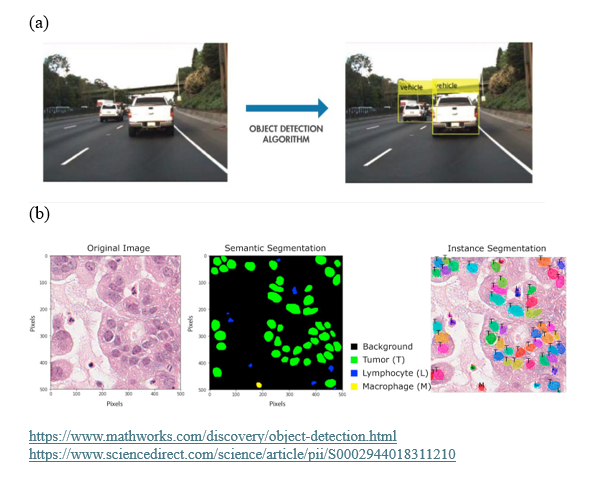
Figure 2. Examples of conventional object-detection paradigms and their limits for particulate environmental analysis.(a) Object detection in autonomous driving, where large, visually distinct targets such as vehicles are localized with bounding boxes.(b) Segmentation and instance detection in pathology, where visible cellular or tissue structures are classified at microscopic scale.These applications demonstrate the power of object-centric computer vision when targets are spatially resolvable. However, many microplastics and nanoplastics in real water samples fall below practical imaging limits or appear as irregular, low-contrast, overlapping particles, motivating alternative AI frameworks based on assay-generated optical signals and pattern interpretation.
2. What Is an Optical Assay?
An optical assay is any test in which useful information is inferred from visual or image-captured changes in a sample.
This includes colorimetric reactions, fluorescence outputs, turbidity changes, precipitation patterns, aggregation behavior, phase separation, diffusion fronts, and texture evolution. In these workflows, the image is not a photograph of discrete objects to classify—it is a readout of an underlying chemical or physical process.
3. Beyond Recognition: Assay-Aware AI Traditional object detection asks: “What object is present? Where is it? How many are there?”
Assay-aware AI asks different questions:
What changed in the sample?
How strong is the signal?
What spatial pattern emerged?
How did the pattern evolve over time?
Does the result match a known concentration regime?
This shift moves AI from image recognition toward process interpretation and real-world intelligence.

4. Example Application: Microplastics and Nanoplastics
Microplastic and nanoplastic systems illustrate why object detection alone is often insufficient. Traditional YOLO and ResNet-based models have shown promise for larger microplastics (>100 μm) in controlled laboratory conditions. However, real environmental samples present far greater challenges. Practical detection performance drops dramatically for irregular fragments, low-contrast particles, and sizes below ~100–300 μm due to matrix interference, turbidity, overlapping particles, and camera resolution constraints (Galata et al., 2024; Rermborirak et al., 2025).
For true nanoplastics (<1 μm, and especially <300 nm), direct object detection becomes fundamentally impractical with standard imaging and current computer vision architectures.
These particles are well below the reliable optical resolution limits of most systems and deep learning models trained on macroscopic objects.
Rather than attempting to image and count individual particles, an alternative framework was invented and developed, which generates interpretable optical patterns after reagent introduction. These may include structured textures and composite patterns from mixed particle populations, and time-dependent transformations. The useful information lies in the emergent signal, not in direct particle enumeration.
This principle aligns with prior signal-generation frameworks analogous to PCR and ELISA, where the target is inferred through generated output rather than direct visualization.(Signal Generation and Pattern-Based Detection: Microplastic and Nanoplastic Assays as Corollaries to PCR and ELISA https://doi.org/10.5281/zenodo.19521084 )
Figure 1. Why object detection alone is insufficient for microplastic and nanoplastic analysis. When many people think of computer vision, they assume object detection frameworks such as YOLO. However, in real environmental samples, practical detection limits are often constrained to larger particles (e.g., ~100–300 μm) by camera resolution, image down-sampling, turbidity, overlap, and low contrast. This creates a major gap relative to nanoplastics (~100 nm) and many smaller microplastics, motivating alternative AI approaches based on optical signals, patterns, and assay-generated information rather than direct particle localization alone.
Figure 4. Three practical limitations of YOLO / object detection for microplastics analysis. Conventional object-detection systems can be highly effective for large, visually distinct targets, but important constraints arise in environmental particulate workflows. (1) Detection limit: practical performance in real samples often degrades below larger particle sizes because of camera resolution, image down-sampling, and low signal-to-noise, leaving many smaller microplastics and nanoplastics below reliable direct-detection thresholds. (2) Irregular shapes: real environmental plastics are frequently fragments and fibers rather than clean, regular objects, reducing localization accuracy. (3) Real-world performance: turbidity, salinity, debris, overlap, and heterogeneous backgrounds can substantially lower performance outside controlled laboratory images. Together, these limitations motivate complementary AI approaches based on optical assays, pattern recognition, and signal generation rather than direct object localization alone. Detailed version of Figure 4 (Figure 5) at end of paper.

5. Example Application: Copper Detection The same AI framework extends beyond particulate systems. In preliminary copper assay work, concentration-dependent color changes were observed following reagent-mediated complex formation, with visually distinguishable signals at higher concentrations and future potential for sub-visual computer vision analysis. Matrix behavior across freshwater and saltwater conditions was also comparable under tested conditions. This demonstrates that the model is not limited to microplastics—it is AI for optical assays more broadly.
6. Why Real-World Deployment Matters Many powerful analytical methods remain centralized, expensive, or difficult to deploy frequently in the field. AI-enabled optical assays support a different model: smartphone-compatible workflows, portable testing, decentralized data collection, repeated monitoring, lower-cost screening, rapid pilot programs, and broader geographic coverage. This is especially relevant for environmental monitoring and public health epidemiological studies and monitoring.
7. Real-World Intelligence The value of an assay extends beyond the test result to what happens next. When connected to software platforms, repeated testing can generate longitudinal trends, hotspot maps, before/after intervention comparisons, anomaly alerts, operational dashboards, and smarter resource allocation. The image becomes data. The data becomes insight. The insight enables action.
8. A Generalizable Framework The same architecture may eventually apply across domains such as environmental contaminants, water quality, heavy metals, biological fluids, wellness monitoring, industrial process control, food and agriculture testing, and educational science tools. The unifying principle is simple: where a system generates interpretable optical change, AI can help read it.
9. Strategic Implications The future of applied AI may include two parallel tracks:
Track 1: Object-Centric AI — Recognition, counting, segmentation.
Track 2: Assay-Centric AI — Signal interpretation, process analytics, field diagnostics, environmental intelligence.
Both are valuable. The second category remains underappreciated but may prove especially powerful for decentralized, real-world applications.
10. Conclusion Object detection has been one of the great success stories of computer vision. But it is not the endpoint of visual intelligence. Many important systems communicate through reactions, transformations, and emergent optical behavior rather than discrete objects. By designing AI to interpret these signals, we open a broader category of real-world tools for science, health, industry, and environmental management.
The next wave of vision systems may not simply ask, “What is in the image?” They may ask, “What is happening in the sample?”


Comments