
Part 1: Microplastics and Nanoplastics in Asian Seafood Supply Chains: Occurrence, Co-Contaminants, Synergistic Risks, and Plastisphere Interactions

AbstractMicroplastics (MPs, <5 mm) and nanoplastics (NPs, <1 μm) are pervasive in Asian marine environments, particularly in high-production areas such as the South China Sea, Johor Straits, and Southeast Asian aquaculture zones. Driven by plastic waste, intensive farming, and coastal dynamics, these particles enter seafood supply chains through direct ingestion and act as “Trojan horses” for co-contaminants (heavy metals, PFAS, antibiotics, pesticides) while serving as scaffolds for microbial biofilms known as the plastisphere.
This review synthesizes recent data (2020–2026) on MP/NP occurrence in commercially relevant seafood (bivalves, crustaceans, fish), co-contaminant interactions, plastisphere-mediated pathogen enrichment, and synergistic risks to food safety and human health. New experimental observations demonstrate that microplastics increase bacterial turbidity in culture (consistent with biofilm formation) and that natural polysaccharides (e.g., okra and marshmallow root extracts) induce visible flocculation and turbidity reduction — supporting a dual-mechanism mitigation strategy (physical aggregation + antimicrobial activity). A Z-model perspective further explains how aggregation reduces accessible surface area, limiting microbial colonization.
Premium restaurant chains and seafood suppliers can leverage proactive multi-contaminant testing and field-deployable tools (e.g., the EcoExposure smartphone platform) to strengthen supplier audits, ESG reporting, MSC/ASC compliance, and brand protection. This Part 1 paper provides the scientific foundation; a companion Part 2 details practical supply-chain screening protocols and mitigation strategies for Asian restaurant operations and aquaculture. This paper is also available at:

Figure 1. Microplastics as vectors (“Trojan horses”) for co-contaminants and microbial colonization.
Conceptual schematic illustrating the role of microplastics as carriers of multiple co-contaminants, including heavy metals (Hg, Cd, Pb, As), PFAS (per- and polyfluoroalkyl substances), antibiotics, and pesticides. Due to their hydrophobic surfaces, charge interactions, and high surface-area-to-volume ratios, microplastics adsorb and concentrate these compounds, facilitating transport through aquatic systems and into seafood supply chains. In parallel, microplastics support the formation of plastisphere biofilms composed of bacteria, fungi, and extracellular matrix components, further enhancing persistence and potential biological interactions. Together, these processes contribute to increased exposure and synergistic risk.
1. Introduction
Asia dominates global seafood production and trade, with Singapore serving as a major import hub. However, intense coastal development, aquaculture expansion, and plastic pollution have led to widespread MP/NP contamination. MPs adsorb hydrophobic and charged pollutants, amplifying exposure in the food chain. This review synthesizes recent data (2020–2026) on occurrence in Asian seafood, co-contaminant interactions, health implications, and practical testing advancements for restaurant supply chains.
2. Occurrence of Microplastics and Nanoplastics in Asian Seafood
Microplastics (MPs, <5 mm) and nanoplastics (NPs, <1 μm) are now recognized as pervasive contaminants in Southeast Asian coastal waters, driven by high plastic waste inputs, intensive aquaculture, shipping, and monsoon-driven runoff. Systematic reviews of 39 studies across Southeast Asia document extreme concentrations: up to 238,000 particles L⁻¹ in surface waters, >200,000 particles kg⁻¹ in sediments, and notable atmospheric deposition (up to 40 particles m⁻² d⁻¹).
Johor and Singapore Straits (key supply-chain corridor for Singapore seafood imports) show particularly high localized contamination. Surface-water concentrations range from 106–238 particles mL⁻¹ in the Johor Strait and 143–196 particles mL⁻¹ in the Singapore Strait, with fragments dominating (70 %), followed by films (25 %) and fibers (5 %). Over 98.9 % of particles are <500 μm, and abundance increases 1.1–1.7× during the monsoon season due to rainfall and sediment resuspension. Dominant polymers include polyethylene (PE), polypropylene (PP), and polystyrene (PS).

Figure 2. Conceptual map of microplastic hotspots in Asian seafood supply chains (2020–2026).
Heatmap visualization based on synthesis of published studies reporting microplastic concentrations in surface waters, sediments, and seafood-relevant environments across Southeast Asia. Regions shown (e.g., Johor Strait, Singapore Strait, Mekong Delta, South China Sea) reflect areas of consistently elevated microplastic presence associated with urbanization, aquaculture activity, riverine inputs, and coastal dynamics. Color gradients represent approximate concentration ranges derived from heterogeneous literature sources and should be interpreted as relative intensity rather than precise quantitative values. Dominant polymer types (PE, PP, PS) and major seafood import routes are included to illustrate supply-chain relevance.
Key findings in commercially relevant seafood (Singapore markets and regional studies):
Bivalves (mussels, clams, oysters, rock oysters) and crustaceans (shrimp, crabs) exhibit the highest accumulation rates due to filter-feeding behavior. MPs are widespread in Singapore retail seafood (mussels, clams) with shapes including pellets, fragments, and fibers (PE and PP most common). Similar high loads are reported in Malaysian bivalves from the Strait of Malacca.
Fish from the South China Sea and Straits of Malacca show occurrence rates of 93.7 % (Beibu Gulf) to near-ubiquitous in Malaysian commercial species. Average abundances reach 1.02–10.28 particles per individual (higher in pelagic fish), with MPs found in gastrointestinal tracts (GIT), gills, and occasionally edible muscle tissue. Fiber-shaped particles (black dominant) predominate; smallest sizes recorded are 0.04 mm in South China Sea fish tissues.
Aquaculture vs. wild catch: Farmed species (e.g., Asian seabass, shrimp in ponds) often show elevated MP levels from contaminated feeds, pond water, and plastic equipment. Wild-caught fish reflect broader environmental hotspots but can have comparable or lower loads depending on habitat (pelagic > demersal in some studies).
Nanoplastics remain far less studied than MPs due to analytical challenges, yet they pose greater bioavailability risks. Their dramatically higher surface-area-to-volume ratio enables easier cellular uptake, translocation across tissues (including edible muscle), and amplified interactions with biological membranes compared with larger MPs. Recent work highlights NPs as a growing concern in Asian seafood pathways.
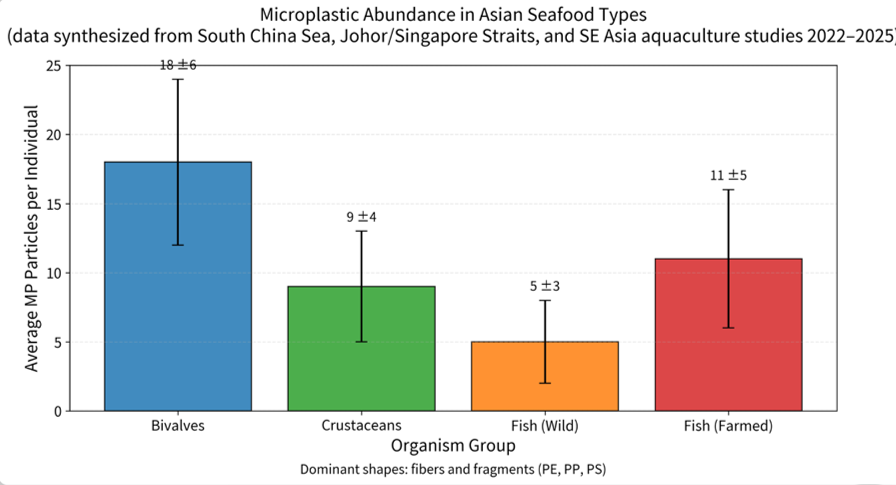
Figure 3. Average microplastic abundance in commercially relevant Asian seafood types (data synthesized from South China Sea, Johor/Singapore Straits, and SE Asia aquaculture studies 2022–2025). Error bars represent approximate standard deviations. Dominant shapes: fibers and fragments (PE, PP, PS).
Summary Table 1: Occurrence of MPs/NPs in Asian Seafood (Selected Recent Studies)
Organism Group / Species | Location / Region | MP Abundance (typical range) | Dominant Characteristics | Key Findings / Notes | Selected Citation(s) |
Bivalves (mussels, clams, oysters) | Singapore markets; Malaysia (Strait of Malacca) | Widespread (high accumulation) | Fragments, fibers; PE, PP dominant | Filter-feeders show highest loads; common in retail seafood | Singapore market survey (2022); Malaysian bivalve studies |
Crustaceans (shrimp, crabs) | SE Asia aquaculture & coastal | Elevated in farmed species | Fibers, fragments | High due to filter-feeding & pond plastics | Regional reviews (2024–2025) |
Fish (pelagic & demersal) | South China Sea; Beibu Gulf; Johor/Singapore Straits | 1.02–10.28 particles/ind. (93.7 % occurrence) | Fibers (black dominant); <500 μm (98 %); PE, PP, PS, PET | GIT & gills primary sites; some muscle translocation; pelagic often higher | Ibrahim et al. (2025); Koongolla et al. (2022) |
Aquaculture species (e.g., Asian seabass, shrimp) | South China Sea ponds; regional farms | Higher than wild in many cases | Fragments & fibers from equipment/feeds | Contaminated water & plastic gear amplify uptake | Shufol et al. (2025); aquaculture reviews |
Nanoplastics (general seafood) | Asian marine & aquaculture waters | Less quantified; smaller sizes (<0.1 mm) | High surface area; translocate to tissues | Greater bioavailability & cellular risk than MPs | Thakur et al. (2025) review |
3. Co-occurrence with Other Environmental Contaminants
Microplastics (MPs) and nanoplastics (NPs) function as “Trojan horses,” adsorbing and transporting a wide range of co-pollutants while facilitating microbial colonization (plastisphere). This vector effect increases the bioavailability and internal exposure of contaminants in marine organisms and seafood supply chains.
Heavy Metals (Hg, Cd, Pb, As): Singapore Food Agency (SFA) routinely monitors imported and local seafood and reports that levels of heavy metals remain generally within acceptable regulatory limits. However, significant source variability exists, particularly in aquaculture from polluted coastal waters. Aged or biofouled MPs exhibit greater affinity for metal adsorption, enhancing uptake and trophic transfer. Studies in Southeast Asian lagoons (e.g., Songkhla Lagoon, Thailand) have documented positive correlations between MP abundance and metals such as Zn and Cu in sediments.
PFAS (“forever chemicals”): Strong positive correlations exist between MP burden and PFAS concentrations in marine fish. In a 2024 South China Sea study of 14 fish species, individuals with higher microplastic loads showed significantly elevated levels of fluoroquinolones and perfluoroalkyl acids (including PFOS). MPs increase PFAS bioaccumulation by acting as carriers that shift internal contaminant profiles toward more persistent long-chain compounds.
Antibiotics & Residues: Widespread in aquaculture across Vietnam, China, and Thailand, where antibiotics are used prophylactically. MPs co-occur with these residues and promote horizontal gene transfer of antibiotic resistance genes (ARGs). In aquaculture systems and mariculture sediments, MPs enrich host bacteria (e.g., Pseudomonas, Shewanella) and significantly amplify ARG prevalence, creating a reservoir that threatens food safety.
Pesticides & Others: Hydrophobic pesticides and personal care products readily adsorb onto plastic surfaces. Synergistic toxicity has been observed; MPs concentrate these compounds, leading to enhanced effects on aquatic organisms compared with either pollutant alone.
Figure 1. Microplastics as vectors (“Trojan horses”) for co-contaminants and microbial colonization.
Conceptual schematic illustrating the role of microplastics as carriers of multiple co-contaminants, including heavy metals (Hg, Cd, Pb, As), PFAS (per- and polyfluoroalkyl substances), antibiotics, and pesticides. Due to their hydrophobic surfaces, charge interactions, and high surface-area-to-volume ratios, microplastics adsorb and concentrate these compounds, facilitating transport through aquatic systems and into seafood supply chains. In parallel, microplastics support the formation of plastisphere biofilms composed of bacteria, fungi, and extracellular matrix components, further enhancing persistence and potential biological interactions. Together, these processes contribute to increased exposure and synergistic risk.
Mechanisms include surface hydrophobicity (promoting organic pollutant sorption), surface charge and zeta potential interactions, polymer ageing/weathering (increasing porosity and binding sites), and biofouling (conditioning films that facilitate further adhesion). These processes collectively elevate internal exposure in organisms and enable trophic transfer into seafood.
Summary Table 2: Co-occurrence of MPs/NPs with Key Contaminants in Asian Seafood Contexts
Co-Contaminant | Key Examples in Asian/Seafood Contexts | Observed Facts/Effects | Primary Mechanisms | Relevance to Restaurant Supply Chains | Selected Key Citations |
Heavy Metals | Hg, Cd, Pb, As; Zn & Cu in SE Asia lagoons | SFA: generally compliant in Singapore markets, but high source variability; MPs enhance uptake | Ageing/biofouling, surface charge, hydrophobicity | Strengthens supplier audits; explains variability in imported seafood | SFA (2025); Pradit et al. (2024); Duong et al. (2026) |
PFAS | PFOS, PFOA, long-chain PFCAs in South China Sea fish | Positive correlation: fish with more MPs have significantly higher PFAS levels | Adsorption + bioaccumulation shift | Supports ESG testing beyond regulations; consumer health angle | Yu et al. (2024); Wang et al. (2025) |
Antibiotics & Residues | Fluoroquinolones, tetracyclines in Vietnam/China/Thailand aquaculture | MPs promote ARG enrichment and horizontal gene transfer in plastisphere | Microbial selection + gene transfer on MPs | Critical for aquaculture supplier screening & food-safety risk | Xie et al. (2024); Su et al. (2025); Rossi et al. (2025) |
Pesticides & Others | Hydrophobic pesticides, PPCPs | Synergistic toxicity; MPs concentrate and vector these compounds | Hydrophobicity & surface sorption | Adds to multi-contaminant risk profile for premium sourcing | Concha-Graña et al. (2022); synergistic toxicity studies (2025) |
4. Plastisphere-Mediated Biological Amplification
In addition to chemical co-contaminants, microplastics serve as scaffolds for microbial colonization through the formation of plastisphere biofilms. These structures facilitate the persistence and transport of bacteria and fungi, including known pathogens such as E. coli and Salmonella.
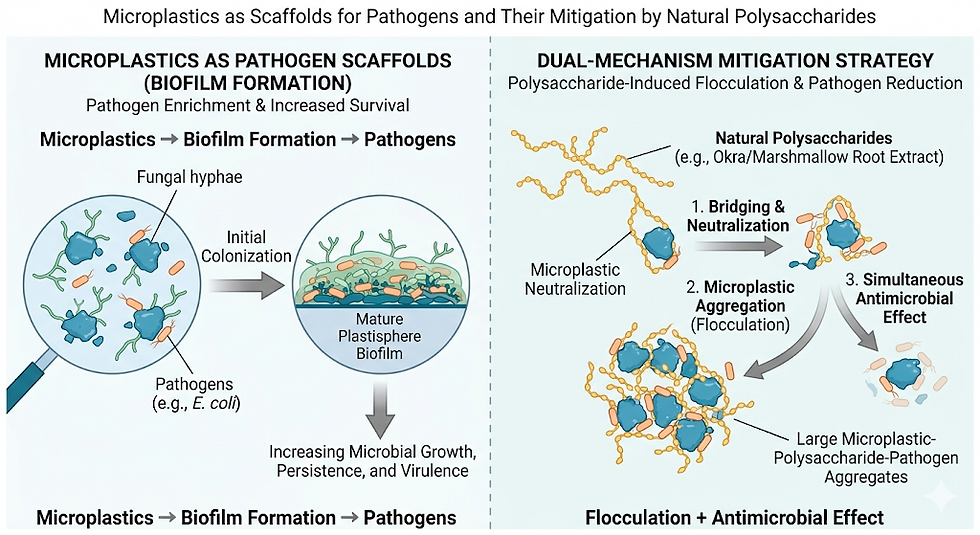
Figure 4. Microplastics as pathogen scaffolds and dual-mechanism mitigation via natural polysaccharides.
Conceptual schematic illustrating (left) the role of microplastics as scaffolds for microbial colonization and plastisphere biofilm formation, enabling increased pathogen persistence, and (right) a proposed dual-mechanism mitigation strategy using natural polysaccharides (e.g., okra- and marshmallow root–derived compounds). Polysaccharides are hypothesized to induce (1) bridging and neutralization of microplastic surfaces, leading to (2) aggregation (flocculation) and reduction in accessible surface area, alongside (3) potential direct antimicrobial effects. Together, these mechanisms may disrupt microplastic-mediated biofilm formation and reduce associated microbial load. Conceptual model informed by literature and supported by preliminary experimental observations.
Pioneering work established the plastisphere concept, revealing diverse heterotrophs, autotrophs, predators, symbionts, and opportunistic pathogens on marine plastic debris. Subsequent studies confirm that plastisphere communities in coastal and aquaculture settings (including Asian waters) selectively enrich pathogens and antibiotic resistance genes, amplifying food-safety risks in seafood supply chains.
Surface Chemistry Driving Adhesion Hydrophobic polymer surfaces of MPs rapidly adsorb dissolved organic matter, forming a conditioning film that promotes irreversible microbial attachment and biofilm maturation. This process is enhanced by surface roughness, charge interactions, and extracellular polymeric substances (EPS), creating protected micro-niches.
Size-Dependent Effects (NPs vs. MPs) Nanoplastics (<1 μm) exhibit dramatically higher surface-area-to-volume ratios, enabling stronger interactions with microbial membranes, greater cellular uptake, and amplified toxicity compared to larger MPs. While MPs primarily serve as structural scaffolds for mature biofilms, NPs can directly disrupt cell membranes and alter microbial behavior, intensifying synergistic risks in water and seafood.
5. Experimental Observations Supporting Plastisphere Formation and Mitigation
To evaluate the role of microplastics in microbial growth and the potential for mitigation, a series of proof-of-concept experiments were conducted using liquid bacterial cultures (LB broth) with and without microplastics. Consistent with plastisphere formation described in prior literature, the presence of microplastics in bacterial cultures was associated with increased turbidity relative to controls, suggesting enhanced microbial aggregation and biofilm-like behavior. This observation aligns with the hypothesis that microplastics provide additional surface area and scaffolding that facilitate microbial colonization and persistence.
To explore potential mitigation strategies, natural polysaccharides, including okra-derived compounds and marshmallow root extracts, were introduced into microplastic-containing bacterial systems. Samples treated with these polysaccharides demonstrated visibly reduced turbidity compared to untreated microplastic–bacteria mixtures, with partial clarification of the medium. While the baseline color and optical properties of LB broth introduce inherent variability, these changes were consistently observed across samples and timepoints.
These findings are consistent with a dual-mechanism interpretation: (1) physical aggregation (flocculation) of microplastics, reducing their effective accessible surface area and ability to act as microbial scaffolds, and (2) a potential direct antimicrobial effect of the polysaccharide compounds. Together, these results provide preliminary experimental support for the hypothesis that removal or aggregation of microplastics may disrupt plastisphere-mediated microbial persistence, with implications for both environmental and food system applications.

Figure 5. Experimental validation of microplastic-mediated turbidity and polysaccharide-induced mitigation.
Representative grayscale images of liquid cultures showing differences in turbidity across conditions. Microplastic-containing bacterial samples exhibit increased turbidity relative to controls, consistent with enhanced aggregation and biofilm-like behavior. Addition of natural polysaccharides (e.g., okra-derived compounds, marshmallow root extract) results in partial clarification of the medium. These observations support a dual-mechanism interpretation involving microplastic aggregation (flocculation) and potential antimicrobial effects. Images were converted to grayscale to enhance visualization of turbidity differences.
Z-Model Perspective on Surface Accessibility and Aggregation
From a Z-model perspective, microplastics and nanoplastics can be viewed as collections of accessible surface sites (“Z-sites”) that enable interaction with surrounding molecules, particles, and microorganisms. The total accessible surface area (ASA)—rather than particle count alone—governs the likelihood of adsorption, microbial attachment, and biofilm formation. This helps explain why even low particle counts can have outsized biological effects: dispersed particles present a high effective ASA, supporting colonization and persistence of bacteria and other organisms within plastisphere biofilms.
Aggregation and flocculation reduce this effective interaction capacity by collapsing accessible surface area into fewer exposed interfaces. When microplastics are bridged into larger clusters (e.g., via natural polysaccharides), many previously accessible Z-sites become internally buried or sterically shielded. This reduces available binding sites for microbial adhesion and limits the spatial scaffolding required for biofilm growth. In parallel, aggregation can facilitate removal (e.g., sedimentation or filtration) and may contribute to secondary effects on microbial viability by disrupting surface-mediated attachment, altering local microenvironments, or enhancing contact with antimicrobial compounds. While these mechanisms require further quantitative characterization, they provide a useful framework for understanding how physical aggregation and biological effects can act synergistically in microplastic mitigation strategies.
6. Challenges of Detecting Microplastics / Nanoplastics in Saltwater Systems
Detecting microplastics and nanoplastics in saltwater environments presents unique technical challenges compared to freshwater systems. High ionic strength, dissolved salts, and complex organic matter can alter particle behavior, including aggregation, dispersion, and surface interactions. These conditions often interfere with traditional detection methods, which rely on filtration, optical clarity, or chemical digestion. As a result, many standard laboratory workflows developed for freshwater or controlled samples perform poorly in marine and coastal environments.
These challenges highlight the importance of methods capable of operating across complex matrices and mixed particle populations, including saltwater systems and multi-scale microplastic–nanoplastic mixtures.
In addition, saltwater matrices frequently contain co-existing particulates, biological material, and dissolved compounds, making it difficult to isolate and quantify microplastics without extensive preprocessing. This creates a gap between laboratory-based methods and real-world conditions in aquaculture, coastal monitoring, and seafood supply chains. Field-deployable approaches that operate directly in intact saltwater samples, without requiring extensive preparation, are therefore critical for scalable monitoring in these environments.
7. Simultaneous Detection of Microplastics and Nanoplastics
While many current approaches focus primarily on microplastics, emerging evidence suggests that nanoplastics may play an equally, if not more, significant role in environmental and biological systems. Due to their smaller size and higher surface-area-to-volume ratio, nanoplastics exhibit increased reactivity, mobility, and potential for interaction with biological tissues and contaminants.
Importantly, real-world samples rarely contain only one size class of particles. Instead, microplastics and nanoplastics coexist as mixed populations, often interacting dynamically within the same system. The ability to detect and analyze both simultaneously provides a more complete representation of total particle burden and exposure. Approaches that capture multi-scale particle interactions within a single sample offer a significant advantage over methods that require separate workflows or focus on a narrow size range.
8. Conclusions & Future Directions
MP/NP contamination with co-pollutants represents a manageable risk for forward-looking chains. Proactive testing, especially via accessible multi-analyte tools, enhances safety, sustainability, and competitiveness. Future work: Longitudinal monitoring in supply chains, standardized protocols, and mitigation via circular economy approaches.
Together, these findings demonstrate that microplastics and nanoplastics in seafood systems are not isolated contaminants, but components of complex, multi-scale environmental interactions involving chemical co-contaminants, microbial colonization (plastisphere), and surface-mediated processes such as aggregation and adsorption. These dynamics occur across diverse matrices—including saltwater environments—and within mixed particle populations spanning microplastics and nanoplastics in the same sample.
While this work focuses on occurrence, mechanisms, and detection capabilities, including recent experimental observations and emerging frameworks such as the Z-model, these insights naturally extend toward practical implementation. In particular, the ability to detect contaminants across complex environments enables new approaches to distributed monitoring, hotspot identification, and evaluation of mitigation strategies over time.
A companion paper (Part 2) builds on this foundation to outline practical supply-chain testing protocols, screening strategies, and mitigation approaches for aquaculture systems and seafood operations, translating these scientific insights into operational workflows.
Keywords: microplastics, nanoplastics, seafood, Asia, plastisphere, co-contaminants, PFAS, heavy metals, sustainable sourcing, multi-analyte testing, ESG, food safety.
References
Arina, N., et al. (2025). Microplastics contamination in coastal environment of Southeast Asia: A systematic review. Science of the Total Environment.
Bhagwat, G., et al. (2021). Understanding the fundamental basis for biofilm formation on plastic surfaces. Frontiers in Microbiology.
Concha-Graña, E., et al. (2022). Synergistic effects of microplastics and pesticides on aquatic organisms. Environmental Pollution.
Curren, E., et al. (2023). Spatiotemporal characterisation of microplastics in the Johor and Singapore Straits. Heliyon, 9(2), e12815. https://doi.org/10.1016/j.heliyon.2023.e12815
Ibrahim, A. N., et al. (2025). Microplastic prevalence in marine fish from the South China Sea. Frontiers in Marine Science.
Koongolla, J. B., et al. (2022). Microplastic prevalence in marine fish from onshore Beibu Gulf, South China Sea. Frontiers in Marine Science, 9, 964461. https://doi.org/10.3389/fmars.2022.964461
Lo, L. S. H., et al. (2025). Bacterial pathogen assemblages on microplastic biofilms in coastal waters. Marine Pollution Bulletin.
Nath, J., et al. (2023). Interaction of microbes with microplastics and nanoplastics in aquatic environments. Pathogens.
Pradit, S., et al. (2024). Microplastic–heavy metal interactions in Southeast Asian coastal lagoons. Science of the Total Environment.
Putra, Z. A., et al. (2025). Utilization of okra seed extract as a natural coagulant for microplastic mitigation. Regional Studies in Marine Science.
Singapore Food Agency (SFA). (2025). Heavy metals in seafood – Monitoring and surveillance reports. https://www.sfa.gov.sg
Srinivasan, R., et al. (2025). Fenugreek and okra polymers as treatment agents for microplastic removal. ACS Omega.
Su, L., et al. (2025). Microplastics as vectors of antibiotics and antibiotic resistance genes in Thai and Vietnamese aquaculture sediments. Environmental Pollution.
Thakur, R., et al. (2025). Review of mechanisms and impacts of nanoplastic toxicity in aquatic organisms. Environmental Science & Technology.
Witsø, I. L., et al. (2024). Wastewater-associated plastispheres: A hidden habitat for microbial pathogens? PLoS One, 19(11), e0312157. https://doi.org/10.1371/journal.pone.0312157
Xie, X., et al. (2024). Microplastics promote antibiotic resistance gene transfer in aquaculture systems of Vietnam and China. Journal of Hazardous Materials.
Yu, F., et al. (2024). Co-occurrence of microplastics and per- and polyfluoroalkyl substances (PFAS) in marine fish from the South China Sea. Marine Pollution Bulletin.
Zettler, E. R., Mincer, T. J., & Amaral-Zettler, L. A. (2013). Life in the “Plastisphere”: Microbial communities on plastic marine debris. Environmental Science & Technology, 47(13), 7137–7146. https://doi.org/10.1021/es401288x


Comments