Part 2: Microplastics and Nanoplastics in Asian Seafood Supply Chains: Practical Supply-Chain Screening, Mitigation Strategies, and Implementation for Restaurants and Aquaculture
- Melinda Chu
- May 11
- 9 min read

AbstractBuilding directly on the scientific foundation established in Part 1—which detailed the pervasive occurrence of microplastics (MPs) and nanoplastics (NPs) in Asian seafood systems, their function as “Trojan horses” for co-contaminants (heavy metals, PFAS, antibiotics, pesticides), plastisphere-mediated pathogen enrichment, synergistic risks, and experimental observations on polysaccharide-induced flocculation. This companion paper translates those findings into actionable, industry-oriented operational strategies.
Part 1: Microplastics and Nanoplastics in Asian Seafood Supply Chains: Occurrence, Co-Contaminants, Synergistic Risks, and Plastisphere Interactions
Focus is placed on practical screening at critical control points, distributed field-deployable monitoring tools (e.g., the modular EcoExposure platform), natural polysaccharide-based mitigation approaches, and implementation frameworks tailored for seafood supply chains, premium restaurant groups, and aquaculture operators in Singapore and broader Asia.
Recent literature demonstrates that okra- and fenugreek-derived polysaccharides can achieve substantial reductions in microplastic burdens across ocean, freshwater, and groundwater matrices, while emerging bioremediation approaches using EPS-secreting microalgae provide additional ecological mitigation opportunities. Together, these approaches may help strengthen supplier auditing, improve environmental oversight, support MSC/ASC sustainability frameworks, and enhance ESG reporting initiatives.
A practical implementation roadmap, pilot framework, and operational considerations are provided. Collectively, Parts 1 and 2 establish a scientific-to-operational framework for addressing microplastic and nanoplastic risks in Asian seafood supply chains through scalable environmental monitoring and mitigation strategies.
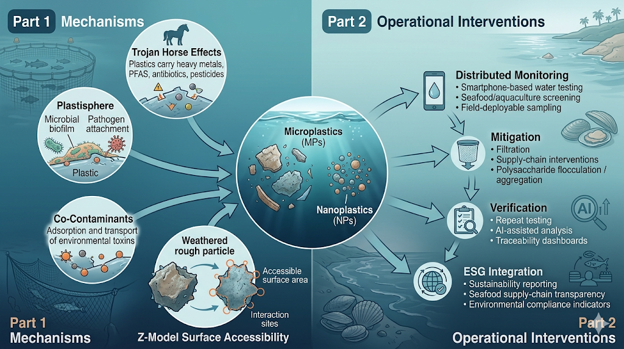
Figure 1. Conceptual framework integrating the mechanistic principles described in Part 1 with the operational implementation strategies presented in Part 2. Microplastics and nanoplastics (MPs/NPs) function as surface-active carriers for co-contaminants (“Trojan horse” effects), microbial colonization (“plastisphere” interactions), and environmental transport processes influenced by accessible surface area and weathering-dependent interaction behavior (Z-model framework). These mechanistic insights inform practical interventions across seafood and aquaculture supply chains, including distributed field monitoring, mitigation strategies, verification workflows, and ESG-integrated environmental reporting systems.
1. IntroductionPart 1 established that MPs/NPs are pervasive throughout Asian seafood supply chains, including the South China Sea, Johor and Singapore Straits, Mekong Delta systems, and aquaculture-intensive coastal regions. These particles function not only as contaminants themselves, but also as vectors for co-contaminants and microbial colonization through plastisphere formation.
Aquaculture systems may amplify exposure through contaminated pond water, feeds, plastic equipment, transport systems, and environmental runoff. Simultaneously, restaurant supply chains face increasing pressure related to sustainability, traceability, food safety, ESG metrics, and supplier transparency.
This Part 2 paper provides the practical operational counterpart to Part 1. Emphasis is placed on identifying critical intervention points, enabling scalable distributed monitoring, evaluating practical mitigation approaches, integrating natural polysaccharide-based strategies, and outlining implementation pathways for seafood operations and aquaculture systems. Rather than replacing centralized laboratory methods, the approaches discussed here are intended to complement existing workflows by enabling more frequent, geographically distributed, and operationally practical screening.
2. Operational Gaps in Current Seafood Monitoring Workflows Despite increasing awareness of MPs/NPs in seafood systems, current monitoring workflows remain difficult to operationalize across dynamic and geographically distributed supply chains.
Several limitations reduce the practicality of existing approaches for real-world seafood operations: centralized laboratory dependence, lengthy turnaround times, destructive preprocessing workflows, incompatibility with rapid procurement decisions, limited testing frequency, matrix interference in saltwater systems, and difficulty scaling across distributed suppliers.
These challenges are particularly important in Southeast Asian seafood systems, where environmental conditions may vary rapidly due to monsoon dynamics, aquaculture density, shipping activity, urban runoff, and coastal pollution variability. Traditional workflows are often episodic and retrospective, whereas seafood procurement and aquaculture operations require near-real-time environmental awareness. This creates a significant gap between laboratory characterization and operational supply-chain management. Accordingly, distributed smartphone-enabled environmental monitoring platforms and practical field-screening workflows may provide an important complementary layer for longitudinal environmental intelligence.
3. Critical Control Points in Asian Seafood Supply Chains High-priority intervention points identified in aquaculture and seafood supply chains include:
Aquaculture pond inflows and intake water
Feeds and plastic-associated farm equipment
Harvesting and transport systems
Central-kitchen receiving and processing
Processing environments with potential GI-tract to tissue transfer
Final storage and retail handling
Targeted interventions at these stages may help reduce cumulative MP/NP exposure before products reach consumers. Particularly important risk-amplification factors include aged plastic infrastructure, contaminated sediments, aquaculture pond recirculation, and biologically active plastisphere biofilms.
4. Practical Screening and Multi-Analyte Monitoring Protocols Existing laboratory workflows may be difficult to deploy routinely across distributed seafood supply chains, especially in marine and aquaculture environments with complex saltwater matrices. Operationally practical monitoring protocols may therefore prioritize rapid field deployment, minimal preprocessing, longitudinal repeatability, and integration into existing supplier auditing workflows.
Recommended Environmental Monitoring Approaches Water Sampling
1–5 L grab samples from pond inflows, intake systems, coastal holding areas, or transport systems
Longitudinal repeat sampling during seasonal shifts and monsoon periods
Simultaneous assessment of MPs/NPs, turbidity, heavy metals, surrogate PFAS-associated indicators, surfactants, and antibiotic-associated environmental markers
Seafood Sampling Representative batch sampling may focus on GI tract analysis, gill-associated accumulation, bivalves and crustaceans, and edible tissues in higher-risk species.
Suggested Monitoring Frequency
Quarterly for stable suppliers
Increased monitoring during monsoon or runoff-heavy periods
Event-triggered monitoring after environmental incidents
Table 1. Example Screening Framework for Seafood Supply Chains
Matrix / Group | Priority Targets | Example Sampling Approach | Suggested Frequency | Example Operational Response |
Pond / Source Water | MPs/NPs, turbidity, metals | 1–5 L grab sample | Quarterly + monsoon | Source review or mitigation |
Bivalves / Crustaceans | MPs/NPs, co-contaminants | Composite organism sampling | Batch or quarterly | Supplier review or mitigation |
Fish (pelagic/demersal) | MPs/NPs, PFAS-associated contaminants | GI/gill sampling | Quarterly | Procurement scoring integration |
Processing Water | Turbidity, MPs/NPs | Intake/process water sampling | Monthly | Filtration review |
Figure 2. Conceptual workflow for distributed environmental intelligence across seafood and aquaculture supply chains. Sampling may occur at multiple points, including aquaculture systems, seafood processing facilities, distributors, and coastal environments. Portable distributed screening workflows generate field-based environmental data using scalable smartphone-enabled assays and AI-assisted analysis. Aggregated results contribute to environmental intelligence systems capable of identifying contamination patterns, informing mitigation strategies, and supporting supplier feedback loops, corrective actions, and ESG-oriented reporting frameworks.
Field Detection Challenges in Aquaculture and Seafood Supply-Chain MatricesDetecting microplastics and nanoplastics in saltwater environments presents unique technical challenges compared to freshwater systems, as detailed in Part 1. High ionic strength, dissolved salts, and complex organic matter alter particle behavior, including aggregation, dispersion, and surface interactions. These conditions often interfere with traditional detection methods that rely on filtration, optical clarity, or chemical digestion. As a result, many standard laboratory workflows developed for freshwater or controlled samples perform poorly in marine and coastal environments typical of Asian aquaculture ponds, coastal holding areas, and seafood processing facilities.
In addition, real-world samples rarely contain only one size class of particles; microplastics and nanoplastics coexist as mixed populations that interact dynamically within the same matrix. This creates a significant operational gap between centralized laboratory characterization and the need for rapid, on-site decision-making in geographically distributed supply chains.
Distributed, low-preprocessing tools such as the modular EcoExposure smartphone platform are therefore operationally essential. They enable direct testing in intact saltwater samples, support simultaneous multi-analyte assessment, and deliver repeatable results without extensive sample preparation—directly addressing the matrix challenges highlighted in Part 1 while providing the near-real-time environmental intelligence required for supplier audits, procurement decisions, and aquaculture management.
5. Field-Deployable Multi-Analyte Monitoring PlatformDistributed monitoring approaches may help address several operational gaps identified in current seafood monitoring systems. The modular EcoExposure platform is designed as a field-deployable smartphone-enabled optical monitoring framework intended to support distributed environmental monitoring, multi-analyte assessment, longitudinal trend analysis, and operational screening across complex matrices, including saltwater systems.
The platform architecture is designed to support future modular expansion into MPs/NPs, turbidity, heavy metals, surfactants, PFAS-associated indicators, and additional environmental analytes. Potential operational advantages include rapid field deployment, reduced dependence on centralized workflows, repeatable longitudinal sampling, distributed supplier participation, and scalable environmental data collection. Importantly, these approaches are intended as complementary operational tools rather than replacements for confirmatory laboratory methods where required by regulation.
Related platform paper: Chu, M. B. (2026). Toward a Multi-Analyte Smartphone Platform for Scalable Global Water Intelligence. DOI: 10.5281/zenodo.19675066
6. Mitigation Strategies: Natural Polysaccharides, Bioremediation, and Operational ControlsPart 1 experimental observations demonstrated that natural polysaccharides (including okra-derived compounds and marshmallow root extracts) induced visible flocculation and turbidity reduction in microplastic-associated bacterial systems. These observations are consistent with (1) physical aggregation/flocculation, (2) reduction in accessible surface area (Z-model framework), and (3) potential secondary antimicrobial effects.
Recent literature strongly supports the broader applicability of natural coagulants and ecological mitigation approaches. Plant-based natural coagulants such as okra and fenugreek polysaccharides achieved substantial reductions in microplastic burdens: ~80 % in ocean water, 80–90 % in groundwater, and ~77 % in freshwater combinations (Srinivasan et al., 2025). These quantitative results align closely with the dual-mechanism flocculation and turbidity reduction observed in the Part 1 bacterial-culture experiments.
Bioremediation approaches using EPS-secreting microalgae (Chroococcidiopsis cubana) have demonstrated 91 % polystyrene MP removal in aquatic systems, offering additional ecological options compatible with aquaculture ponds (Das et al., 2025). Additional operational mitigation controls include filtration optimization, biodegradable gear adoption, supplier environmental scorecards, plastic infrastructure reduction, and wastewater management improvements.
Table 2. Example Mitigation Strategies Across Supply Chains
Stage | Strategy | Mechanism | Implementation Complexity | Supporting Literature |
Source Water / Ponds | Okra/fenugreek dosing | Flocculation + aggregation | Low–Moderate | Srinivasan et al. (2025) |
Pond Systems | EPS-secreting microalgae | Hetero-aggregation | Moderate | Das et al. (2025) |
Processing Systems | Filtration optimization | Physical removal | Moderate | Wu et al. (2023) |
Supplier Operations | Plastic reduction | Source control | Low | APEC (2024) |

Figure 3. Conceptual schematic illustrating polysaccharide-induced aggregation as a potential mitigation strategy for microplastics and nanoplastics (MPs/NPs) in aquaculture systems. Dispersed weathered particles exhibit high accessible surface area (ASA) and numerous exposed interaction sites (“Z-sites”), facilitating contaminant adsorption, plastisphere formation, and environmental transport interactions. Natural polysaccharide-mediated aggregation promotes clustering of MPs/NPs into larger floc-like structures, reducing accessible surface exposure and altering interaction–transport behavior within the Z-model framework. These aggregation processes may support operational mitigation pathways including sedimentation, filtration, skimming, and distributed environmental management strategies within seafood and aquaculture systems.
7. Distributed Monitoring and Environmental IntelligenceOne potential advantage of distributed smartphone-enabled environmental monitoring systems is the ability to generate longitudinal environmental datasets across geographically diverse seafood supply chains. This distributed model may allow aquaculture operators, seafood suppliers, restaurant receiving facilities, and environmental stakeholders to contribute repeatable environmental observations into broader supply-chain intelligence frameworks. Over time, such systems may support hotspot identification, seasonal variability analysis, supplier benchmarking, ESG reporting, and early environmental trend detection. This distributed environmental intelligence approach may be particularly valuable in Southeast Asia, where coastal conditions, urbanization, aquaculture intensity, and monsoon dynamics contribute to rapidly changing environmental conditions.
8. Implementation Roadmap for Restaurant Chains and Aquaculture OperatorsA practical 6-month pilot framework may include:
Phase 1 — Baseline Characterization
Initial distributed environmental screening
Supplier mapping
Longitudinal baseline collection
Phase 2 — Supplier Engagement
Environmental awareness training
Introduction of mitigation concepts
Initial operational integration
Phase 3 — Pilot Mitigation Trials
Small-scale polysaccharide testing
Filtration optimization
Ecological mitigation pilots
Phase 4 — Verification and Scaling
Repeat longitudinal monitoring
Supplier scorecard development
ESG integration
Procurement workflow integration
Potential applications include MSC/ASC sustainability documentation, supplier differentiation, ESG reporting, and environmental due diligence.
9. Challenges, Cost-Benefit Considerations, and ESG IntegrationSeveral challenges remain: environmental matrix variability, standardization, seasonal fluctuations, and the need for harmonized longitudinal workflows. However, distributed monitoring and operational screening may provide several potential advantages: increased monitoring frequency, improved supplier visibility, reduced reliance on episodic centralized testing, enhanced ESG reporting capabilities, and stronger environmental transparency. Natural polysaccharide approaches additionally offer potential sustainability benefits due to biodegradability, food-grade compatibility, and reduced reliance on synthetic flocculants.
10. Asia-Specific Relevance and Future DirectionsAsia dominates global seafood production and aquaculture growth, while Singapore functions as a major seafood import and distribution hub. Simultaneously, rapid urbanization, coastal industrialization, aquaculture expansion, and monsoon-driven environmental variability contribute to heightened MP/NP exposure complexity throughout regional supply chains. These conditions create a strong need for scalable, distributed, and operationally practical environmental monitoring systems. Future work may include longitudinal validation studies, combined monitoring + mitigation pilots, expanded aquaculture collaborations, integration with ESG frameworks, and broader multi-analyte environmental intelligence systems. Potential partnerships with academic institutions, aquaculture groups, seafood operators, and environmental organizations may help accelerate validation and deployment efforts across Asia-Pacific seafood systems.
11. ConclusionsParts 1 and 2 together demonstrate that MP/NP contamination in seafood supply chains represents not only an environmental challenge, but also an operational monitoring opportunity. The combination of distributed monitoring, scalable environmental intelligence, natural polysaccharide mitigation, ecological remediation, and longitudinal supply-chain screening provides a potential framework for more proactive seafood environmental stewardship. Forward-looking seafood operators, restaurant groups, aquaculture systems, and environmental stakeholders may benefit from integrating scalable monitoring and mitigation workflows into broader sustainability and food-safety initiatives.
Keywords microplastics, nanoplastics, seafood supply chain, aquaculture, ESG, environmental monitoring, distributed monitoring, plastisphere, PFAS, heavy metals, natural polysaccharides, okra, fenugreek, mitigation, seafood operations, Singapore, Asia, EcoExposure platform
References
APEC Oceans and Fisheries Working Group. (2024). Workshop on Microplastics in the Coastal Aquaculture Input Chain: From the Perspectives of Policy, Regulation and Research to a Recommendation of a Mitigation Plan. APEC Project OFWG 03 2021A.
Chu, M. B. (2026). Toward a Multi-Analyte Smartphone Platform for Scalable Global Water Intelligence: Beyond Microplastics/Nanoplastics. Zenodo. https://doi.org/10.5281/zenodo.19675066
Das, P., et al. (2025). Bioremediation of microplastics in aquatic environment using EPS-secreting microalgae and LCA study. Chemical Engineering Science.
Srinivasan, R., Bhuju, R., Azadah, M., et al. (2025). Fenugreek and Okra Polymers as Treatment Agents for the Removal of Microplastics from Water Sources. ACS Omega, 10(15), 14640–14656. https://doi.org/10.1021/acsomega.4c07476
Wu, H., Hou, J., & Wang, X. (2023). A review of microplastic pollution in aquaculture: Sources, effects, removal strategies and prospects. Ecotoxicology and Environmental Safety, 252, 114567. https://doi.org/10.1016/j.ecoenv.2023.114567


Comments