
Phthalates Are Not Microplastics or Nanoplastics: Distinguishing Chemical Plasticizers from Physical Plastic Particles in Human Urine

Abstract
Recent media and commercial reports describing 'plastics in urine' typically refer to phthalate metabolites detected via LC-MS/MS rather than intact microplastic or nanoplastic particles. Although both originate from plastic materials, they represent fundamentally different analytical targets and biological questions.
Phthalates are chemical plasticizers that leach from plastics, are metabolized by the body, and are routinely measured using liquid chromatography-mass spectrometry (LC-MS/MS). In contrast, microplastics and nanoplastics are physical polymer particles requiring entirely different analytical approaches, including microscopy, spectroscopy, optical imaging, and emerging artificial intelligence-assisted methods. However, there are no scalable methods for microplastics/nanoplastics methods / assays and noly have about n = 70-100 samples in the entire literature.
This technical note clarifies the distinction between these forms of plastic exposure, summarizes current urinary testing approaches, and discusses why precise terminology is essential as research and commercial testing continue to expand.
This paper is also available at:
https://doi.org/10.5281/zenodo.21119426

Figure 1. Workflow comparison for urinary detection of phthalates versus microplastics/nanoplastics. Phthalates are measured as chemical metabolites following rapid bodily metabolism (left panel: urine collection → LC-MS/MS analysis → quantitative metabolite concentrations). In contrast, microplastics and nanoplastics require direct physical particle detection (right panel: urine collection → sample preparation with contamination controls → optical imaging, spectroscopy, or AI-assisted computer vision → particle enumeration, sizing, morphology, and polymer identification). These fundamentally different analytical pathways highlight why phthalate testing cannot be equated with MP/NP particle burden assessment. (Note: NP detection in human urine remains particularly limited, with very few published studies globally, many relying on back-calculation methods.)
Table 1
Comparison of Urinary Phthalate and Microplastic Testing
Characteristic | Phthalates | Microplastics | Nanoplastics |
Form | Chemical metabolites | Physical particles | Physical particles |
Origin | Plastic additives (plasticizers) | Fragmented polymers | Nanoscale polymer fragments |
Typical measurement | LC-MS/MS | Microscopy, Raman, FTIR, optical imaging | Advanced microscopy, Raman, AI-assisted imaging |
Current commercial urine tests | Widely available | No standardized clinical test or Research Use Only (RUO) test | No standardized clinical test or RUO test |
Number of samples or papers in the literature | Thousands of samples | ~3 papers (n = ~28 samples total in literature) | ~1-2 papers (n = ~18 samples total in literature) |
Primary biological question | Chemical exposure | Particle burden | Nanoscale particle burden |
Also see Table below for more details about 70-100 samples in total urine microplastic literature.
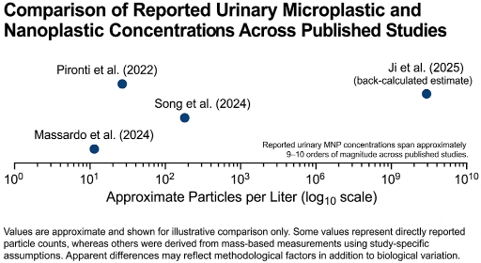
Figure 2. Comparison of Reported Urinary Microplastic and Nanoplastic Concentrations Across Published Studies.
Approximate urinary microplastic and nanoplastic (MNP) concentrations reported in selected published studies after normalization to particles per liter and displayed on a logarithmic (log₁₀) scale. Reported values span approximately 9–10 orders of magnitude, ranging from a few particles per liter in direct-counting studies (Pironti et al., Massardo et al., Song et al.) to approximately 2 × 10¹⁰ particles per liter in estimates derived from mass-based measurements using particle-size assumptions (Ji et al.). Values are shown for illustrative comparison only and should not be interpreted as directly equivalent measurements. Differences may reflect variations in sample preparation, storage conditions, analytical methodologies, size detection limits, reporting frameworks, and assumptions used for mass-to-particle conversion, in addition to potential biological variability. This figure highlights the current challenges in harmonizing urinary MNP measurements across studies and underscores the need for standardized analytical and reporting approaches.
Table 2. Overview of Major Urine MNP Studies (n = 70—100 individuals)
Study | Year | Samples | Method | Reported Result | Approximate Normalized (particles/L) | Notes |
Pironti et al. | 2022 | 6 | Raman microspectroscopy | 7 fragments total | Few MP/L | Sizes 4–15 µm |
Massardo et al. | 2024 | 10 | MicroRaman | Mean 1.28 fragments/sample | ~4–5 MP/L | Sizes 3–13 µm |
Song et al. | 2024 | 12 | Py-GC/MS + LDIR | ~1.5 mg/L and ~15 particles/L | ~15 particles/L | Mass and count reported separately |
Rotchell et al. | 2024 | 38 | μFTIR | Presence confirmed | Low / not quantified | Endometriosis cohort |
Ji et al. | 2025 | 18 | Proteinase K + Py-GC/MS | 0.268 µg/mL (mass) | ~20 billion nanoplastic particles/L* | Back-calculated estimate |
*Approximate value derived using commonly applied particle-size assumptions.
Total samples across major published studies remain approximately 70–100 individuals.
Introduction
Public awareness of plastic exposure has increased dramatically in recent years. Headlines describing "plastics in urine" or "plastics in the body" are now common. While scientifically important, these reports often combine two distinct concepts under the single term plastics.
One category consists of plastic-associated chemicals, including phthalates and bisphenols, which are intentionally added during plastic manufacturing. The second consists of physical plastic particles, including microplastics and nanoplastics, generated through degradation, weathering, and fragmentation of polymer materials.
Although both originate from plastic products, they differ substantially in chemistry, biological behavior, analytical methodology, and interpretation. Consequently, a positive phthalate test should not be interpreted as evidence of intact microplastic particles in urine, and vice versa.
Plastic-Associated Chemicals
Phthalates are low-molecular-weight organic compounds widely used as plasticizers to increase flexibility and durability of polymer products. Because many phthalates are not permanently bound to the polymer matrix, they can migrate into food, beverages, dust, cosmetics, medical devices, and the surrounding environment.
Following exposure, phthalates are rapidly metabolized and excreted in urine as specific metabolites. For this reason, urinary metabolite analysis using LC-MS/MS has become the standard method for human biomonitoring.
Commercial urine panels measuring phthalate metabolites are now widely available through specialized clinical and wellness laboratories and represent an established approach for assessing recent exposure to plastic-associated chemicals.
Microplastics and Nanoplastics
Microplastics and nanoplastics represent an entirely different analytical target.
Rather than dissolved chemicals, these are intact physical polymer particles that may vary in size, morphology, weathering state, polymer composition, and surface chemistry.
Detecting these particles requires fundamentally different laboratory workflows, often involving particle isolation, contamination control, microscopy, Raman spectroscopy, FTIR spectroscopy, pyrolysis-based methods, optical imaging, or emerging AI-assisted image analysis.
Unlike urinary phthalate testing, no universally accepted standardized clinical method currently exists for routine urinary microplastic or nanoplastic testing.

Figure 3.
Distinguishing plastic particles from plastic-associated chemicals. Microplastics and nanoplastics are physical polymer particles, whereas phthalates are chemical plasticizers intentionally added during plastic manufacturing. Although both originate from plastic materials, they differ fundamentally in their chemistry, biological behavior, analytical methods, and interpretation. Urinary phthalate testing measures metabolites of plastic-associated chemicals, typically by liquid chromatography-mass spectrometry (LC-MS/MS), whereas detection of microplastics and nanoplastics requires particle-based analytical methods such as microscopy, spectroscopy, optical imaging, or emerging AI-assisted image analysis.
Current State of Urinary Microplastic Research
Published studies investigating intact microplastics in human urine remain limited. As discussed in our previous review of urinary microplastic detection, only a small number of human studies have been published to date, collectively evaluating approximately 70–100 participants using heterogeneous analytical methodologies.
Differences in sample preparation, contamination control, particle identification, reporting units, and analytical instrumentation currently limit direct comparison between studies.
Accordingly, urinary microplastic detection remains an emerging area of biomonitoring research rather than an established clinical laboratory test.
Why the Distinction Matters
As commercial environmental exposure testing expands, it is increasingly important to distinguish between chemical biomarkers of plastic exposure and measurements of physical plastic particles.
Although both provide valuable information regarding human exposure, they answer different scientific questions.
Measurement of urinary phthalate metabolites evaluates exposure to plasticizer chemicals.
Measurement of urinary microplastics seeks to determine whether intact polymer particles are present.
Confusing these approaches may unintentionally obscure important methodological differences and create the impression that routine testing for urinary microplastics is already established, when in reality standardized methods remain under active development.
Conclusion
Growing public interest in plastic exposure presents an opportunity to improve scientific communication.
Phthalates, bisphenols, and other plastic-associated chemicals are not synonymous with microplastics or nanoplastics. They represent distinct forms of exposure requiring different analytical techniques and yielding different biological information.
As research progresses toward standardized methods for detecting intact microplastic and nanoplastic particles in biological samples, greater precision in terminology will benefit researchers, clinicians, policymakers, and the public.
Selected Related Technical Notes
Chu MB. Challenges in Interpreting Reported Urine Microplastic and Nanoplastic Levels: Mass- vs. Particle-Based Measurements
Chu MB. Preliminary Report: Scalable Detection of Microplastics and Nanoplastics in Human Urine. Zenodo. 2026.https://doi.org/10.5281/zenodo.19342198
Chu MB. Toward Scalable Detection of Microplastics and Nanoplastics in Human Biological Systems: Alignment with STOMP Objectives and Preliminary Feasibility Data. Zenodo. 2026.https://doi.org/10.5281/zenodo.19393852
Chu MB. Toward a Harmonized Framework for Standardization for Scalable and Reproducible Measurement of Microplastic and Nanoplastic Monitoring in Human Urine. Zenodo. 2026.https://doi.org/10.5281/zenodo.19645419
Chu MB. A Multi-Matrix Approach to Microplastic and Nanoplastic Detection Across Environmental and Biological Samples. Zenodo. 2026.https://doi.org/10.5281/zenodo.19462123
Chu MB. Current Practical Limitations of Advanced Spectroscopic and Imaging Methods for Nanoplastics Characterization in Complex Biological Matrices. Zenodo. 2026.https://doi.org/10.5281/zenodo.19450733
Chu MB. Signal Generation and Pattern-Based Detection: Microplastic and Nanoplastic Assays as Corollaries to PCR and ELISA. Zenodo. 2026.https://doi.org/10.5281/zenodo.19521084
Chu MB. A Computer Vision Approach for Non-Enumerative Detection of Microplastic and Nanoplastic Signatures and Mixed Particulate Regimes. Zenodo. 2026.https://doi.org/10.5281/zenodo.19532700
Chu MB. Toward a Global Standard for Field-Based Microplastic and Nanoplastic Detection: Conceptual Framework, Version 1. Zenodo. 2026.https://doi.org/10.5281/zenodo.19536054
Chu MB. How Back-Calculation and Particle Size Assumptions in Lab-Based Methods Can Significantly Alter Reported Microplastic and Nanoplastic Particle Counts. Zenodo. 2026.https://doi.org/10.5281/zenodo.19646694
Chu MB. Human Health Impacts and Tissue Deposition of Microplastics and Nanoplastics: Organ-System Summary (April 2026). Zenodo. 2026.https://doi.org/10.5281/zenodo.19663994
Chu MB. Nanoplastics Are Not Simply Smaller Microplastics: Accessible Surface Area Drives Their Disproportionate Human Health Risks. Zenodo. 2026.https://doi.org/10.5281/zenodo.19663224
Chu MB. The Z-Model Applied to Microplastics and Nanoplastics: Accessible Surface Area, Mixed-Scale Environmental Samples, and Policy-Relevant Detection. Zenodo. 2026.https://doi.org/10.5281/zenodo.19661568
This paper is also available at:
https://doi.org/10.5281/zenodo.21119426


Comments