
Saltwater Changes Everything: Why Coastal and Ocean Microplastic Detection Requires New Field Methods

Abstract
Oceans and saltwater bodies comprise approximately 97 % of Earth’s water by volume and form the dominant component of the planet’s hydrosphere. Despite this overwhelming scale, virtually all existing microplastic and nanoplastic detection methods have been developed and validated in freshwater systems, simplified laboratory matrices, or centralized lab workflows. Practical, scalable, field-ready methods optimized for the high-ionic-strength, dynamic conditions of coastal, estuarine, and open-ocean environments remain almost nonexistent.
This paper presents a field-oriented framework for scalable microplastic and nanoplastic screening in saltwater and coastal environments using a smartphone-based zero-shear optical interaction platform. Supporting evidence includes controlled saltwater laboratory studies, mixed microplastic–nanoplastic experiments, time-resolved optical behavior, and real-world field validation in San Francisco Bay under fully uncontrolled outdoor conditions. These findings demonstrate that effective ocean monitoring requires methods engineered specifically for real marine environments rather than adapted from freshwater or idealized lab conditions. Saltwater is not a niche use case — it is the dominant matrix on Earth and one of the greatest opportunities for meaningful environmental impact. This paper is also available at: https://doi.org/10.5281/zenodo.19674868
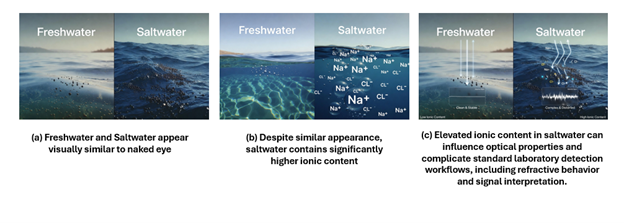
Figure 1. Why Saltwater Requires Distinct Detection Strategies. Comparison of freshwater and saltwater as environmental testing matrices. Although both may appear visually similar at first glance (a), saltwater contains substantially higher concentrations of dissolved ions (b), creating a chemically distinct environment. These matrix differences can alter particle interactions, optical behavior, and analytical performance, which may complicate conventional laboratory workflows and support the need for field methods specifically designed for coastal and marine water (c).
1. Introduction
Plastic pollution in marine environments is now recognized as a planetary-scale issue. Surface oceans contain an estimated 170–358 trillion plastic particles, with additional burdens accumulating in sediments, coastlines, estuaries, and food webs. Even if all new plastic emissions stopped today, existing materials would continue fragmenting into microplastics and nanoplastics for decades to centuries.
Despite this urgency, routine monitoring in coastal and ocean systems remains severely limited by cost, logistics, and analytical methods that were not designed for high-salinity, dynamic marine realities.
2. Why Saltwater Is a Different Scientific Problem
Saltwater may appear visually similar to freshwater, but it is a chemically and physically distinct matrix. Key differences include high ionic strength, dissolved salts (Na⁺, Cl⁻, Mg²⁺, Ca²⁺), variable salinity due to tides and runoff, suspended sediments and organics, biofilms, natural colloids, variable sunlight, and wave-driven transport dynamics. These factors can significantly influence particle aggregation, optical behavior, scattering, and reaction kinetics. Methods validated only in clean freshwater or simplified lab conditions often fail to translate reliably to estuarine, coastal, or open-ocean environments.
3. Why Centralized Labs Alone Are Not Enough
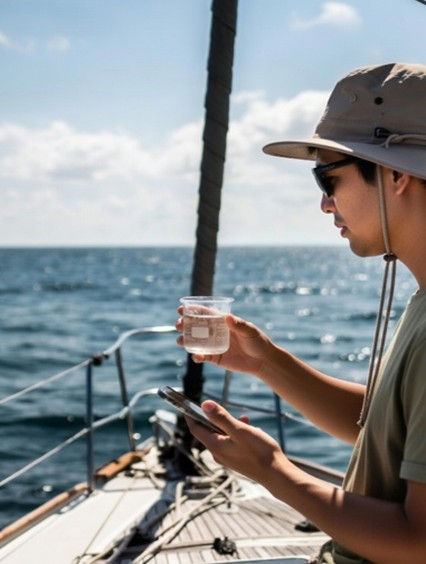
Centralized laboratories face inherent limitations for large-scale ocean surveillance: high cost of sampling campaigns, transport delays, sparse geographic coverage, episodic rather than continuous sampling, and limited accessibility for coastal communities, NGOs, and citizen scientists.
4. A Simple, Field-Optimized Zero-Shear Interaction-Based Workflow for Saltwater
The EcoExposure framework uses an interaction-based approach rather than direct particle counting. The general workflow is straightforward and field-friendly:
User: Collect Water Sample → Add Reagent → Wait → Capture Smartphone Image
Team: Aggregate Date → Analyze Patterns → Map / Act
By focusing on time-evolving optical structures generated through particle–particle and particle–reagent interactions, the system can operate effectively in complex, high-ionic-strength matrices without extensive pretreatment or desalting. The portable kit allows deployment anywhere — including on boats, beaches, ports, or remote coastal sites.
5. The Z-Model: Why Surface Interactions Matter
Traditional approaches often emphasize particle number or bulk mass. The Z-Model reframes particles as collections of interaction-active surface sites (“Z-sites”), where behavior is driven by accessible surface area rather than count alone. Under this framework, smaller particles (including nanoplastics) may generate disproportionately high reactive surface area, and mixed MP–NP systems can produce emergent behaviors not predicted by count alone. This model helps explain why nanoplastics, weathered particles, and mixed systems produce distinct assay signatures in real marine matrices.

Figure 3. Conceptual Overview of the Z-Model Figure 3 illustrates the overall conceptual framework of the Z-Model, showing how accessible surface area (ASA) is decomposed into discrete quantized Z-sites whose density and interactions (Z-events) govern the fundamental behavior of particulate systems. Optical signatures are shown as observable proxies for the underlying surface-mediated physical, chemical, and biological processes.
6. Saltwater Laboratory Validation
Controlled studies using seawater-mimic matrices demonstrated that high ionic strength did not abolish the assay’s core behavior. Preservation of concentration-dependent trajectories, bounded read times, endpoint convergence, and low-concentration sensitivity were observed without desalting or extensive pretreatment. These results support that salt changes the path of system reorganization more than the existence of detectable signal itself.
7. Non-DLVO Aggregation Mechanisms Enable Robust Performance in High-Ionic-Strength Matrices
Classical colloidal theory (DLVO) predicts that particle aggregation is governed by the balance between attractive van der Waals forces and repulsive electrostatic double-layer forces. In high-ionic-strength environments such as seawater (≈ 0.6 M NaCl, ~35 ppt), the electrostatic barrier collapses, leading to rapid aggregation. However, many real-world systems — particularly those involving polymers, biopolymers, or mixed microplastic–nanoplastic suspensions — deviate significantly from DLVO predictions.
The EcoExposure platform relies on on-DLVO mechanisms, including polymer bridging, entanglement, and hydration-layer structuring. These forces produce aggregation behavior that is largely independent of ionic strength. In controlled experiments spanning a 10⁶-fold difference in ionic strength (double-filtered RO water vs. synthetic seawater), the optical kinetics remained nearly identical: Gradient Edge Contrast (GEC) increased from ~0.38 to 0.44 and Localized Edge Dynamics (LEDyn) declined to ≤ 0.0015, yielding endpoint clarity ≥ 92 % in both matrices (see Non-DLVO Provisional Application for detailed GEC/LEDyn methodology).
This ionic-strength invariance directly explains the platform’s robustness in coastal and marine environments. Traditional DLVO-dependent methods often fail or require extensive pretreatment in saltwater, whereas the non-DLVO interaction regime allows reliable, reproducible optical signatures without desalting or complex sample preparation.
The Z-Model further complements this framework by emphasizing accessible surface-area-driven “Z-site” interactions rather than bulk particle count. Together, these non-DLVO and Z-density principles provide a mechanistic foundation for why the assay maintains consistent temporal fingerprints and spatial organization even in the complex, high-ionic-strength conditions of estuaries, bays, and open ocean waters.
8. Temporal Fingerprints: Measuring Behavior Over Time
Each sample produces a time-resolved trajectory rather than a single static value. Different matrices may alter absolute intensity, yet still preserve recognizable temporal shapes and transitions. This concept of temporal fingerprints is particularly useful in marine settings where changing chemistry and background noise make one-time snapshots less informative than dynamic behavior over time.
9. Mixed Microplastic–Nanoplastic Systems in Saltwater
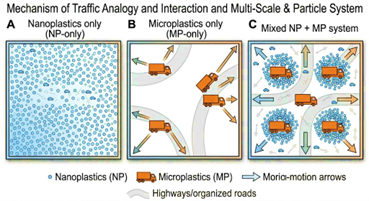
Real environmental water rarely contains only one particle class. Mixed systems containing both microplastics and nanoplastics demonstrated structured optical regimes distinct from either class alone. Microplastics can act as scaffolds or transport pathways for nanoplastic interactions, producing hybrid patterns consistent with Z-density-driven coupling between size classes.
Figure 4. Mixed Microplastic–Nanoplastic Interaction–Transport Coupling (“Highways and Traffic” Analogy). Nanoplastics behave like dense, slow-moving traffic without defined pathways, resulting in distributed fine-scale interactions. Microplastics act as sparse, fast-moving carriers. In mixed systems, microplastics function as “highways” that transport clusters of nanoplastics via surface interactions, producing accelerated, directed aggregation and enhanced radial clearing.
10. Real-World Field Validation: San Francisco Bay
Field studies at Crissy Field East Beach (San Francisco Bay) tested authentic coastal water under fully uncontrolled conditions: natural sunlight with variable intensity and shadowing, uneven surfaces, hand-drawn grids, and no photobox. Treated samples produced reproducible time-dependent pattern formation (diffuse haze at 15 min → distinct radial clearing and structured aggregates at 30 min), clearly distinguishable from controls. Independent replicates showed consistent kinetics, confirming that the signal originates from intrinsic interaction structure rather than perfect laboratory imaging conditions.
11. Asia and Island Nations: A Global Priority for Saltwater Monitoring
Asia accounts for the majority of the world’s coastal population and marine resource dependence. Southeast Asia alone is home to some of the planet’s highest microplastic concentrations in coastal waters, sediments, and biota. Indonesia and the Philippines rank among the top three global contributors to ocean-bound plastic waste, while countries such as Malaysia, Vietnam, and Thailand report seawater microplastic levels reaching tens to hundreds of thousands of particles per liter in some coastal zones.
Island nations and archipelagic states across the region — including the Philippines, Indonesia, Singapore, and the Maldives — are especially vulnerable. These countries rely heavily on marine fisheries and aquaculture for food security, livelihoods (supporting millions of coastal fishers and farmers), coral reef tourism, and export economies. High population density in coastal zones, combined with riverine inputs from major urban centers, drives substantial land-based plastic pollution directly into surrounding seas.
Because Asia’s coastal and marine environments represent both a major source and a major sink of global microplastic pollution, scalable field-ready methods optimized for high-ionic-strength saltwater are not optional — they are essential for effective regional and global ocean protection.
12. Why This Matters Globally
Saltwater and coastal monitoring also impacts every continent and is relevant to fisheries, aquaculture, coral reef protection, ports and harbors, tourism economies, island nations, coastal cities, environmental NGOs, maritime regulators, and citizen science networks. Because marine environments span enormous geography, scalable distributed tools may offer advantages unattainable through centralized systems alone.
13. Implications for Future Water Intelligence Systems
Saltwater detection is not merely one module. It demonstrates a broader principle: if a platform can operate in one of the most complex common water matrices on Earth, extension to other real-world environments becomes more credible. This supports future multi-analyte systems spanning microplastics/nanoplastics, turbidity, metals, surfactants, and regional contamination signatures.
14. Conclusion
Saltwater changes everything. It changes the chemistry, the particle behavior, the logistics, and the scale of the monitoring challenge. Yet it also reveals where scalable environmental tools can have the greatest real-world impact.
The future of ocean microplastic and nanoplastic surveillance may not depend solely on centralized laboratories. It will increasingly rely on practical, robust field methods that bring detection directly to coasts, boats, ports, communities, and everyday users. Because the hardest waters to test may be the most important waters to understand.
Keywords: microplastics, nanoplastics, saltwater monitoring, coastal detection, marine plastic pollution, field-deployable assay, zero-shear optical interaction, Z-Model, EcoExposure, decentralized environmental monitoring
This paper is also available at: https://doi.org/10.5281/zenodo.19674868


Comments