
Smartphone-Based Environmental Exposure Monitoring in Singapore and Asia: A Decentralized Urine Wellness Platform for Longitudinal Observational Studies

Abstract
Singapore and broader Asia are rapidly emerging as major centers for smartphone-enabled wellness technologies, decentralized observational research, preventive health infrastructure, and AI-assisted consumer health platforms. This paper presents the conceptual framework and translational deployment strategy for a smartphone-based urine environmental exposure monitoring platform focused initially on microplastics/nanoplastics (MP/NPs) and future multi-analyte environmental wellness biomarkers.
The EcoExposure™ platform combines smartphone-guided image analysis, cloud-connected workflows, AI-assisted interpretation, and decentralized longitudinal monitoring into a scalable at-home wellness infrastructure model. The system integrate will integrate with global electronic data capture (EDC) platform supporting decentralized observational studies internationally, including highly remote and distributed environments.
Unlike traditional centralized laboratory testing, the platform is intentionally designed for low-burden observational deployment with minimal infrastructure requirements, enabling scalable longitudinal environmental exposure monitoring from home settings. Preliminary exploratory R&D studies have already included decentralized donor urine matrices, operational stress-testing workflows, and exploratory nanoparticle-focused experiments under real-world handling conditions.
Singapore’s innovation ecosystem, translational research infrastructure, regulatory collaboration initiatives, and high digital adoption rates make it an attractive environment for pilot deployment and future regional expansion across Asia. This paper is also available at: https://doi.org/10.5281/zenodo.20149289
1. Introduction
Environmental exposures including microplastics/nanoplastics (MP/NPs), PFAS, heavy metals, airborne pollutants, and other emerging contaminants are receiving increasing attention across public-health, wellness, and preventive-health communities globally. Simultaneously, Asia is experiencing rapid growth in smartphone-enabled wellness technologies, decentralized observational research models, and AI-assisted consumer health infrastructure.
Singapore in particular has positioned itself as a regional hub for biomedical innovation, translational research, preventive health technologies, and digital infrastructure development.
This environment creates opportunities for new categories of smartphone-powered environmental wellness monitoring platforms that combine decentralized participation, AI-assisted workflows, and longitudinal real-world data collection.
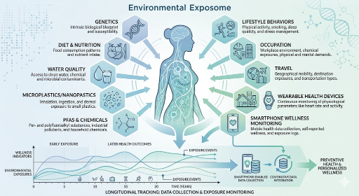
Figure 1. Conceptual Environmental Exposome Monitoring Framework. Environmental-health outcomes may be influenced by the interaction of genetics, lifestyle, environmental exposures, geography, and behavioral factors over time. Longitudinal smartphone-based wellness monitoring may support scalable real-world environmental exposome data generation.
The EcoExposure™ platform was developed as a smartphone-first environmental wellness monitoring system designed to support scalable at-home longitudinal exposure tracking. Rather than relying on centralized laboratory instrumentation or dedicated hardware readers, the workflow leverages smartphone imaging, app-guided protocols, cloud-based infrastructure, and AI-assisted interpretation.
The current platform focuses initially on urine-based environmental exposure monitoring workflows, while future expansion may include broader multi-analyte and multi-matrix environmental-health applications.

Figure 2. Proposed Translational Deployment Pathway for Smartphone-Based Environmental Wellness Monitoring in Singapore and Asia.The EcoExposure™ platform is positioned initially as a wellness-oriented observational monitoring system using decentralized smartphone workflows, longitudinal environmental exposure tracking, and scalable cloud-connected infrastructure. The proposed pathway emphasizes iterative observational deployment, longitudinal dataset generation, and future regional expansion across Asia.
2. Why Singapore and Asia Are Attractive for Smartphone-Based Wellness Monitoring and Decentralized Observational Studies
Singapore’s healthcare and innovation ecosystem is particularly well suited for smartphone-based wellness technologies and decentralized observational monitoring platforms due to:
high smartphone penetration
advanced digital infrastructure
strong biomedical and translational research ecosystem
supportive innovation environment
growing consumer interest in preventive health and longevity
international clinical research connectivity
highly educated and digitally engaged populations
Importantly, Singapore has increasingly positioned itself as a regional hub for translational innovation, AI-enabled health technologies, and scalable consumer-facing wellness infrastructure. This creates opportunities for new categories of smartphone-powered environmental wellness monitoring platforms that combine decentralized participation, AI-assisted workflows, and longitudinal real-world data collection.
Singapore’s Health Sciences Authority (HSA) has also emphasized regulatory innovation and international collaboration. In May 2026, HSA and China’s National Medical Products Administration (NMPA) renewed and expanded a bilateral Memorandum of Understanding focused on facilitative regulatory pathways, innovative medical technologies, and enhanced collaboration on health-product evaluation and market access.
This broader trend toward regional regulatory convergence may strengthen Singapore’s role as a strategic launch environment for scalable wellness-oriented and observational monitoring technologies seeking future expansion across Asian markets.
Unlike traditional centralized laboratory testing models, the EcoExposure™ platform is intentionally designed around:
smartphone-native participation
at-home workflows
low operational burden
decentralized observational monitoring
scalable longitudinal participation
minimal infrastructure requirements
The platform is positioned initially as a wellness-oriented observational monitoring system rather than a diagnostic medical device or prescription telehealth platform. Potential applications include decentralized wellness studies, longitudinal environmental exposure tracking, citizen-science initiatives, preventive-health programs, and future population-scale exposome monitoring.
Because the workflow is smartphone-based, decentralized, and low-cost, even relatively modest early consumer adoption may support meaningful recurring revenue generation while simultaneously enabling the creation of large longitudinal environmental exposure datasets. This creates a potentially attractive hybrid model combining consumer wellness deployment with scalable observational research infrastructure.
3. Existing Wellness and Smartphone-Based Testing Ecosystems in the United States and Asia
Existing consumer-facing wellness platforms already demonstrate broad public acceptance of smartphone-connected at-home testing workflows, longitudinal wellness tracking, and decentralized participation models.
Table 1. Selected At-Home Wellness and Smartphone-Based Testing Platforms in the United States and Asia
Product / App | Sample Type | Main Wellness Focus | Primary Market | Regulatory / Positioning | Notes / Relevance |
Vivoo Urine Test Strips + App | Urine | Hydration, pH, vitamins, oxidative stress | Global (US + Asia) | Wellness / consumer product (no diagnostic claims) | Strong smartphone-connected wellness analog |
Oova Hormone Kit + App | Urine | Fertility, hormones, perimenopause | US + international | Wellness / RUO with app integration | Longitudinal tracking precedent |
Vibrant Wellness / MosaicDX | Urine (mail-in) | Toxins, heavy metals, PFAS, mycotoxins | US | CLIA lab; wellness / informational only | Established environmental toxin panel precedent |
Camtech Ideal Health DNA Test | Saliva | Genetics, nutrition, skin, fitness, aging | Singapore / Asia | Wellness-oriented D2C kit + app | Example of Singapore-based consumer wellness platform |
WonderHealth Home Screening | Urine / Blood | Preventive health screening panels | Singapore | Home-based preventive wellness screening | Demonstrates local demand for mailed at-home testing |
Clearblue Fertility Tests | Urine | Ovulation / fertility tracking | Global (including Singapore) | OTC self-testing precedent | Widely accepted pharmacy-based consumer testing model |
EcoExposure™ Platform | Urine | Microplastics/nanoplastics and environmental exposure trend monitoring | Singapore / Asia focus | Wellness / RUO; smartphone-guided observational monitoring | Instant smartphone-enabled environmental exposure trend analysis with longitudinal monitoring potential |
While the United States currently has a more mature ecosystem for toxin and biomarker-oriented wellness testing, Singapore and broader Asia present an attractive environment for smartphone-based preventive wellness technologies and decentralized observational monitoring platforms.
Existing regional companies such as Camtech and WonderHealth demonstrate strong consumer acceptance of at-home and app-connected wellness testing workflows. This creates a potential first-mover opportunity for smartphone-powered environmental exposure monitoring platforms such as EcoExposure™ within the growing Asian preventive health, longevity, and environmental wellness ecosystem.
4. Smartphone-First Longitudinal Environmental Exposure Monitoring
Traditional environmental exposure testing workflows are often expensive, centralized, and difficult to scale longitudinally. These workflows frequently depend on laboratory instrumentation, mail-in logistics, or episodic testing approaches that limit repeated monitoring opportunities.
In contrast, decentralized smartphone-based monitoring enables:
repeated longitudinal measurements
lower operational burden
remote participation
scalable observational studies
real-world environmental exposure tracking
reduced infrastructure requirements
higher-frequency monitoring opportunities
Environmental exposures are dynamic and may vary according to geography, diet, water source, occupation, travel, housing conditions, and lifestyle factors. Longitudinal monitoring may therefore provide more meaningful insights into exposure variability than isolated single timepoint measurements alone.
The EcoExposure™ workflow was intentionally designed around:
smartphone-native participation
minimal hardware requirements
decentralized observational deployment
app-guided image capture
scalable cloud infrastructure
repeatable longitudinal participation
A simple platform used repeatedly across large populations may ultimately generate more practical environmental-health insight than technically sophisticated systems deployed only episodically in centralized laboratory settings.
5. Technology Overview and Operational Workflow
The EcoExposure™ platform integrates:
urine-compatible environmental exposure assay chemistry
smartphone-based image and spectral analysis
AI/computer-vision-assisted interpretation
cloud-connected data infrastructure
longitudinal trend tracking
decentralized participant workflows
integration with electronic data capture infrastructure
The broader operational workflow includes:
Participant onboarding and electronic consent
Shipment of at-home testing kits
Urine collection and guided workflow
Smartphone image capture
Secure cloud upload
AI-assisted environmental exposure trend analysis
Longitudinal observational tracking over time

Figure 3. Smartphone-Based Environmental Exposure Monitoring Workflow. The EcoExposure™ platform uses a smartphone-first decentralized workflow designed for low-burden longitudinal environmental exposure monitoring. Participants perform at-home urine testing with app-guided image capture and cloud-connected AI-assisted environmental exposure trend analysis.
Because the workflow is smartphone-based and integrated with decentralized electronic data capture infrastructure, protocols can be adapted across countries and study populations with relatively minimal operational modification.
Importantly, the system was intentionally designed to minimize operational friction:
no dedicated reader hardware required
no routine clinician involvement required
no centralized laboratory instrumentation required for core workflow operation
minimal participant training burden
compatibility with decentralized at-home participation
The broader platform philosophy emphasizes accessibility, repeatability, scalability, and longitudinal participation rather than episodic centralized laboratory testing alone.
5.1 Current Development Status and Preliminary Translational Readiness
The EcoExposure™ platform advances from prior laboratory development work already performed in human urine matrices under decentralized operational conditions. Preliminary exploratory R&D studies have evaluated multiple independent donor urine samples using standardized dilution workflows, smartphone-compatible optical imaging, environmental exposure assay chemistry, and exploratory computational analysis.
Recent exploratory stress-test experiments included decentralized aged urine samples collected from multiple independent donors under intentionally challenging real-world handling conditions, including delayed storage and transport intervals of approximately 7–10+ days prior to assay processing. Despite expected biochemical drift, baseline color variation, oxidation-associated changes, and donor variability, concentration-dependent optical interaction behavior remained interpretable across donors and matrices. Preliminary nanoparticle-focused exploratory experiments have also demonstrated recognizable concentration-responsive organizational behavior in decentralized urine matrices.
These preliminary studies support several important translational observations:
feasibility of decentralized urine workflows
robustness across donor variability
compatibility with smartphone-based image capture
preservation of interpretable optical interaction behavior under non-ideal real-world conditions
scalability potential for future observational deployment
Regulatory engagement activities have also progressed through submission of an FDA Pre-Submission (Q-Sub) in the United States to obtain early feedback regarding wellness positioning, decentralized workflows, software considerations, and future observational study design.
Together, these activities support progression from exploratory laboratory development toward pilot observational deployment and future translational studies in Singapore and broader Asia.
6. Proposed Translational Deployment Pathway
A proposed translational deployment pathway for Singapore and broader Asia may include:
Continued assay optimization and longitudinal workflow development
Regulatory engagement and wellness-positioning strategy discussions
Pilot decentralized observational study deployment
Longitudinal environmental exposure dataset generation
Expansion into larger observational wellness cohorts
Regional scaling across Singapore and broader Asian markets
Potential future regulatory expansion pathways depending on intended use
This phased strategy allows iterative development of operational workflows, real-world dataset generation, and scalability assessment while maintaining an initial wellness-oriented observational positioning.
7. Potential Applications
Potential future applications may include:
decentralized observational wellness studies
longitudinal environmental exposure cohorts
preventive-health initiatives
environmental-health awareness programs
citizen-science projects
digital wellness pilot programs
future epidemiologic exposure studies
integration into broader longitudinal health studies
smartphone-enabled exposome monitoring
The platform may also support future expansion into additional environmental analytes and multi-matrix exposure monitoring systems.
8. Discussion and Future Directions
The convergence of smartphone technologies, AI-assisted workflows, decentralized observational research infrastructure, and increasing public interest in environmental health creates a unique opportunity for scalable longitudinal environmental exposure monitoring.
Singapore’s innovation ecosystem and broader Asian market environment may provide an attractive setting for early translational deployment and future regional expansion of decentralized wellness-oriented environmental monitoring technologies.
Future directions may include:
larger observational cohort studies
integration with wearable and longevity platforms
expansion of analyte panels
AI-driven exposome modeling
cross-country longitudinal observational studies
integration into preventive-health ecosystems
regional environmental-health datasets across Asia
The broader long-term vision is not simply isolated environmental testing, but the development of scalable decentralized environmental exposome infrastructure capable of supporting longitudinal real-world environmental-health insight generation across large populations.
As environmental-health awareness continues to grow globally, smartphone-powered wellness monitoring platforms may become increasingly important tools for understanding real-world exposure patterns while empowering individuals to participate directly in longitudinal environmental-health data generation.


Comments